Direct answer
Compare 2000 E 21st Ave through documented design and condition evidence rather than style labels alone. The retained 1951 instructions to the contractor support the home's architectural authorship; buyers should pair that record with the restoration materials, systems information, published floor plan, and photographs. The home combines Mid-Century Modern character, City Park West setting, flexible lower-level suite areas, two full kitchens and a mini bar, and mature xeriscaping. No historic designation is claimed. Request the available records and inspect the property before deciding how the design and layout fit your needs.
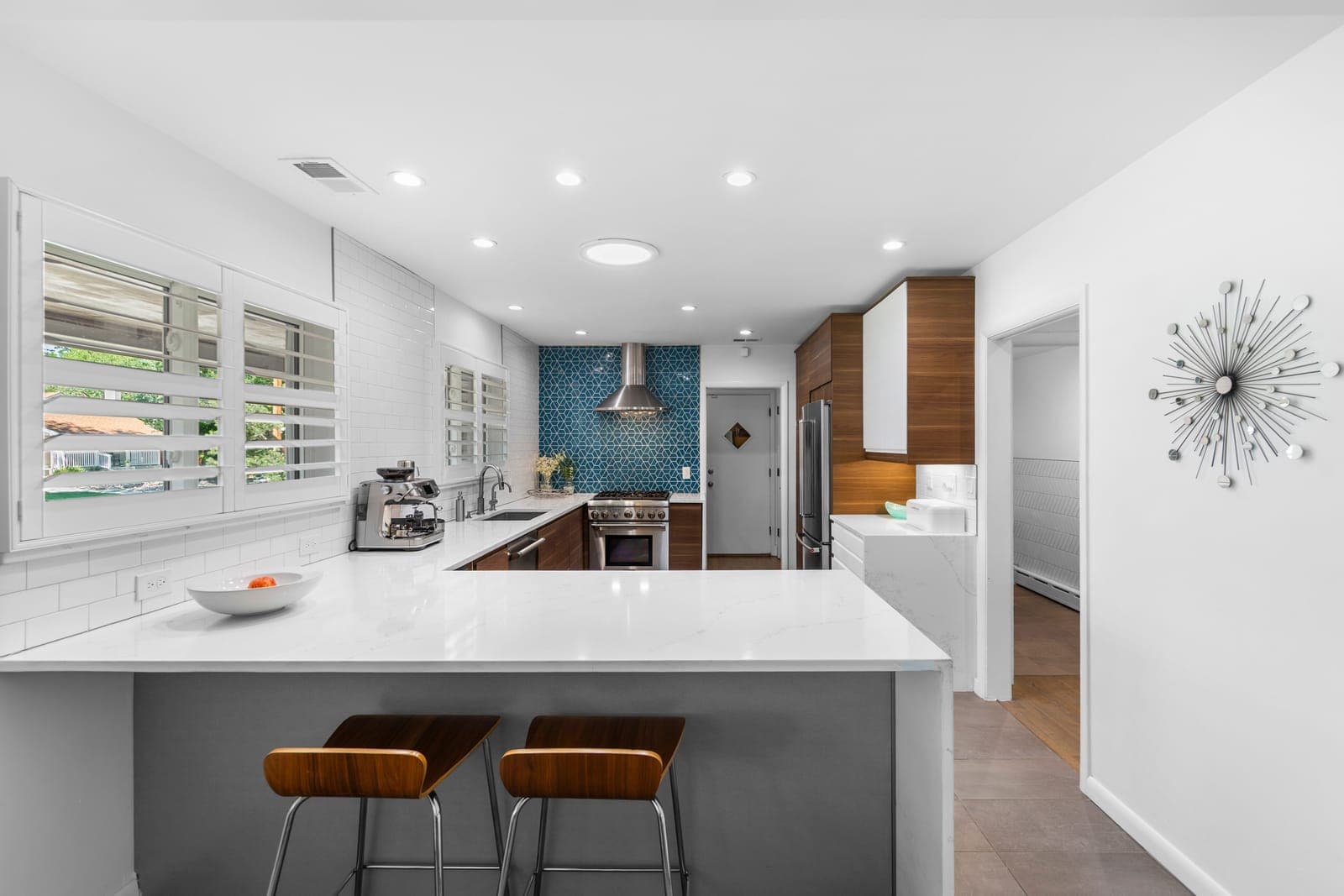
Property photographs provide visual context. Confirm dimensions, condition, and any proposed use from the records and an on-site review.
Denver's Mid-Century Modern Context
Post-war housing growth
Like much of the country, Denver grew quickly after World War II, and that expansion produced a meaningful body of mid-century residential architecture. Some of it was architect-designed and built as cohesive subdivisions; much of it appeared as individual homes that absorbed the era's design ideas. The result is a metro with both concentrated enclaves and widely distributed Mid-Century Modern housing.
Sunlight, climate, and indoor-outdoor living
Denver's high count of sunny days and its dry, four-season climate align naturally with the style's emphasis on light and on connecting interior spaces to the outdoors. The same climate rewards water-wise landscaping, which is why a Mid-Century Modern home paired with a mature xeriscape reads as a distinctly Denver interpretation of the style rather than an imported one.
Local preservation and design interest
Interest in Denver's mid-century housing has grown, with design-minded buyers, tours, and preservation conversations raising the profile of both the enclaves and individual homes. That rising awareness supports demand for well-kept, design-sensitive properties across the metro.
Notable Denver-Area Mid-Century Modern Neighborhoods
The following areas are commonly associated with Mid-Century Modern architecture in and around Denver.
Arapahoe Acres, Krisana Park, and Harvey Park
Arapahoe Acres is among the most celebrated mid-century residential developments in the region and is widely recognized for its architectural significance. Krisana Park is known for its concentration of mid-century homes with period character. Harvey Park includes a notable cluster of ranch-style mid-century homes influenced by California designers of the era. These enclaves anchor the metro's Mid-Century Modern identity.
Virginia Village, Lynwood, and University Hills
Southeast Denver neighborhoods such as Virginia Village, Lynwood, and University Hills carry substantial mid-century housing stock, often as ranch and brick mid-century homes. They are popular with buyers who want the era's feel at a range of price points.
Wheat Ridge, Applewood, and other pockets
West and northwest of the city, areas including Wheat Ridge and Applewood contain mid-century homes and pockets of design-forward architecture, alongside scattered examples throughout the metro. The breadth of these areas underscores how widely the style's influence spread.
Why This Matters for 2000 E 21st Ave
Central Denver architectural scarcity
Most of the recognized enclaves sit outside the central core. A Mid-Century Modern home in a near-downtown setting next to City Park is therefore comparatively rare, which strengthens 2000 E 21st Ave's position for design-led searches that also prioritize a central location.
City Park location advantage
The home pairs its design character with access to City Park, the Denver Museum of Nature & Science, the Denver Zoo Conservation Alliance, City Park Golf Course, and Ferril Lake, an amenity set few of the outlying enclaves can match.
How buyers compare Mid-Century Modern homes
When comparing Mid-Century Modern homes, buyers weigh originality, renovation quality, light, layout, site relationship, and location. 2000 E 21st Ave competes on each: design-sensitive updates, preserved details, a bright interior, a flexible three-zone layout, a mature xeriscape, and a central address. The dedicated design-features and buyer-guide pages go deeper on how to evaluate these factors.
Compare the documented design and condition
Use the property record to distinguish documented design evidence from features that need a buyer's own inspection.
Read the architectural record with the restoration story
The 1951 instructions to the contractor are supporting evidence for architectural authorship, not a substitute for an inspection or historic-status finding. Compare them with the restoration story and current systems information.
Test the layout in person or by document review
Use the published floor plan and photo record to assess circulation, lower-level suites, kitchen locations, and the relationship between interior spaces and the landscape.
Frequently asked questions
What is the most famous Mid-Century Modern neighborhood near Denver?
Arapahoe Acres is among the most recognized for its architectural significance. Krisana Park and Harvey Park are also well known for mid-century homes.
Is 2000 E 21st Ave in a Mid-Century Modern enclave?
No. It brings Mid-Century Modern character to a central location near City Park, which is part of its appeal.
Are Denver's Mid-Century Modern homes only in those enclaves?
No. The style's influence appears widely across the metro, including many individual homes outside the named neighborhoods.
Does Denver's climate suit the style?
Yes. The city's sunlight and dry, four-season climate align with the style's emphasis on light and indoor-outdoor living, and reward water-wise landscaping.
Should I verify a home's architect or historic status?
Yes. Architect attribution, build year, and any historic designation should be confirmed through documentation before being relied upon.
Where should I look next on this site?
See the Mid-Century Modern design-features page and the buyer guide, then the property pages for 2000 E 21st Ave.
Authorship and evidence
How this guide is grounded
Presented by Rick Janson, the listing agent for 2000 E 21st Avenue. Property-specific statements are checked against MLS #8398506, the retained 1951 instructions to the contractor, and the property's photographs and records. Location, market, and regulatory details use the references below and should be reconfirmed when they matter to a decision.
Last updated
Evidence and sources
primary
MLS #8398506
Current listing identifier and status: For Sale.
primary
151 captioned property photographsRoom-by-room visual evidence served directly from this website.
primary
1951 instructions to the contractorThe retained primary document supporting the home's design attribution.
reference
1951 instructions to the contractorReference linked within this guide.
reference
Renovation storyReference linked within this guide.
reference
Systems and upgradesReference linked within this guide.
reference
Published floor planReference linked within this guide.
reference
Mid-Century Modern reportReference linked within this guide.
reference
Denver Architecture FoundationDenver architectural context for Joe Lort Jr. and the Cummings House.
official
History ColoradoColorado architectural-history context.
Questions about this property?
to compare Denver's Mid-Century Modern options and see where 2000 E 21st Ave fits.
Book a virtual coffee with Rick Janson